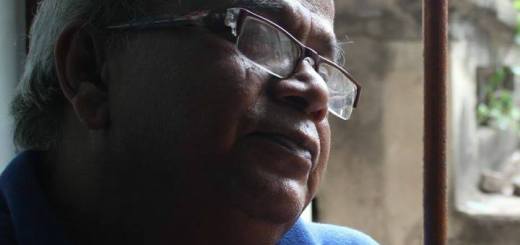
Interview - Ramkumar Mukhopadhyay
Ramkumar Mukhopadhyay is one of the most significant fiction writers in contemporary Bangla literature. His subjects range from rural Bengal to seminar room boredom challenging our so-called urbanity with a very powerful language. His most talked about novel Dhanapatir sinhala yatra, a novel based on Chandimangal received Ananda Puraskar. In spite of being awarded with many prestigious prizes, he still calls himself a little magazine writer. He is one of the participants of the ILF Samanvay this year.

What are your main concerns about the fiction written in Bangla?
I have been writing fiction from the late 70’s. Naturally priorities also change with the time and also with the subject chosen for each novel. But I always try to address the socio-economic condition of the people and their struggle to survive against heavy odds. Political issues also surface in my novels Charane Prantare, Bhanga Nider Dana or Michhiler Pare. In the third novel, five persons from different districts of Bengal came to Kolkata to attend the mass gathering of a political party and lost their way. They passed the winter night in the Brigade Parade Ground narrating their struggle in the journey of their life. They are all marginal people but fight to press their identity.
As we know till your last published novel Dhanapatir Sinhala yatra, your treatment of fiction is not very conventional as it is still practised in Bangla. Like in dukhe keora (a 12 chapter novel) every chapter started with a definition and we see the novel questions those definitions in a very poetic way. What has driven you towards this non-linear fiction pattern?
We have got the fictional form from the West. So we mostly follow the linear form of narration. But India has so many indigenous narrative forms which are very suitable to describe our life and society. I have tried to use the Kathakatha form in my writing. The novel Dukhe Keora is in the form of a dialogue between the author and Dukhe Keora, who sells country liquor which his wife herself prepares. The questions are not there but from the answers, the questions can be imagined. The questions are on such subjects as hunger, health, labour, women, politics, culture, intellectual, war, death etc. The answers challenge our conception of the subject as presented by the authors over the centuries. The man in the margin has his own concept of life based on his own experience of living. This form has a distant connection with Sri Ramakrishna Kathamrita as written by Mahendralal Datta.
Tell us about Dhanapatir Sinhala yatra a little.
Dhanapatir Sinhala Yatra (Dhanapati’s Journey to Sri Lanka) is based on a medieval Bengali kavya called Chandimangal. My novel describes the journey of a merchant from Bengal to Sri Lanka. It is a search for the pre-colonial Bengal, partly Orissa and Sri Lanka also.
Instead of contemporary world you have been writing about the mythical world taking us to our own yet forgotten mythical journey. You are using many words that are retrieved from old Bangla. As an extension of the last question I would like to ask you why have you chosen such path? What attracted you to this way of expression?
In the novel, I have used many words which have been lost from our literature with the introduction of British education. It has delinked us from our history. The lost words are actually our cultural marks.
What are your main concerns about Bangla language in general?
Bangla is spoken in West Bengal, Tripura, Assam, Bihar and Bangladesh and each place has its own character of the language. Even in Bengal, some districts have their own way of speaking the language. This variation is very alluring for a fictionist as these differences lead to a different geo-cultural identity of the people. But from the 50’s of the last century, some newspaper houses took interest in promoting literature. Later television channels also started telecasting serials. Both the medium encouraged fictionalization of urban life and thus middle-class drawing room stories became popular in Bangla literature. The Bangla fictional language became one dimensional. But in the recent time, particularly after a strong Little Magazine movement, the scenario has changed quite considerably. Various experiments are being made now both in fiction and poetry.