Expansion of Shylock’s Business
Globalization, allegory, Shahzad Firdaus’s novel Shylocker Banijyo Bistar
War is the highest form of political struggle. When two nations, two ideologies, two worldviews or any number of them oppose one other and find no other solution to their irreconcilability, war becomes inevitable. It’s the victor’s worldview, his ideology and principle that rein thereafter.
A more sinister mechanism of annihilation transpires simultaneously; annihilation of not only the vanquished life and property but more importantly their ideology, politics and freedom. In Post-Modern Age, this very notion of war as a grotesque display of dismay and arms has been replaced silently and effortlessly to a much more complex mechanism of manufacturing consent, exporting a notion of a democracy absolutely alien to its target, systematic destruction of indigenous cultures and replacing them with a homogeneous western worthlessness and methodical subjugation of conquered communities with a synchronized labeling as an enemy— all these to effortlessly open up new markets in the guise of free trade where the word “free” has a restricted interpretation in accordance to the benefit of the global power, each with a modus operandi unique to its target, ranging from peaceful procedures to violent means. The horrific violence again publicized effortlessly, where media-cameras remain glued to sophisticated machines of mass destruction with the suffering of the oppressed quieted in distant out of focus. With the accumulation of capital, Nation-States are overshadowed by global capital thereby reduced to a mere tool of profiteering. Nations attack militarily inferior nations not for annexation of races but for colonization of resources. This phenomenon has assumed a simple name – Globalization.
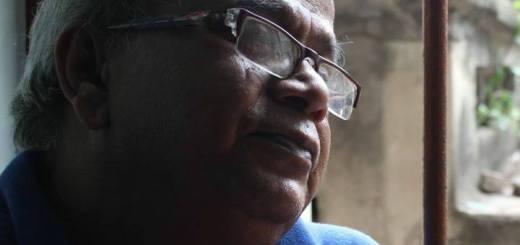
Cover Photo: Shamik Ghosh
Shahzad Firdaus is a writer of exceptional caliber. He explains this grotesque function of globalization through a simple allegorical novel of 108 pages entitled ‘Shylocker Banijyo Bistar’ (Shylock and Sycophants). Sikandar, the Indian appellation of Alexander the Great, is an ordinary mortal struggling to meet ends. On a late night suburban train Sikandar meets Shylock and his sycophants. Firdaus’s Shylock, is Shakespearean in spirit, performing the same function of a ruthless trader, sans the infamous anti-Semitism. Shylock offers Sikandar a business deal, through which he can provide the basic, yet unaffordable, amenities for his family in exchange of his soul.
Sikandar is offered another lucrative business deal of being an agent of Shylock to buy more and more souls, a ploy whose real meaning he will understand through Shylock’s chief companion Antonio, another Shakespearean parable. Shylock has already possessed the majority of world resources and now wants to possess the soul of the world’s population in an effort to set up his ultimate company named Shylock and his Slaves.
The real meaning of selling one’s own soul becomes more perceivable to Sikandar through his Father, Wife and Child. A person who has sold his soul has also sold his affection, his love, his ancestral patronage, culture, language, relationship, motherland and even his right to die. He is only left with one alternative, to gasp and earn commission by becoming another soulless agent of Shylock.
One may or may not agree with the author, but can easily recognize the symbolic meaning of Shylock. Despite writing such immaculate novels at par with the World’s best, Shahzad Firdaus remains a little known author with a microscopic readership in Bengali Literary space with absolute absence in Indian Literary milieu, may be because that space too is owned by Shylock and his Sycophants.