Interview with Novelist Shri Amar Mitra
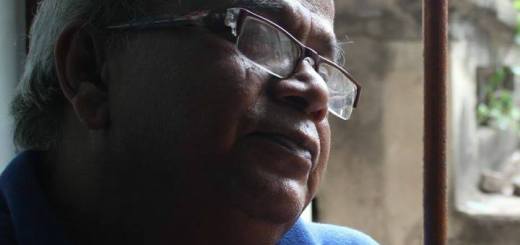
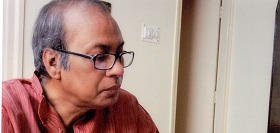
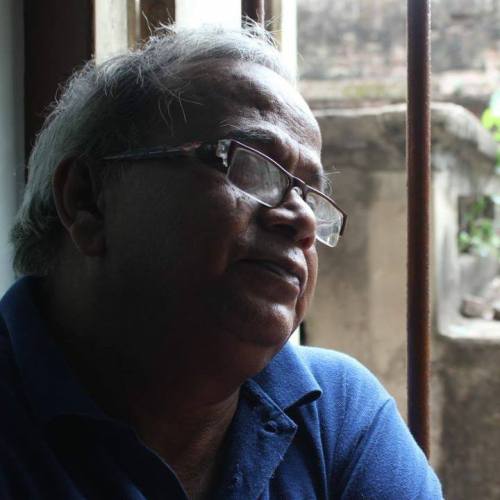
Amar Mitra (born 30 August 1951) is an eminent writer in Bengali living in Kolkata, West Bengal, India. A student of Chemistry, he has been working for the Land Reforms Department of The Government of West Bengal. He was awarded with Sahitya Akademi Award for his novel Dhurbaputra in 2006. He has also received the Bankim Puraskar from Government of West Bengal for his novel, Aswacharit in 2001 and edits the new generation Bengali Webzine Bookpocket.net
1. Many of your characters belong to the other ‘Bengal’. They keep ignoring the scars of partition and continuously thrive to cultivate new relations. Do you repeatedly try to return to the language of your childhood?
Can it be the inheritance of agony? I was born in Dhulihar village of present day Bangladesh where I’ve lived infrequently. From my mother, I’ve heard all about the Kapotaksha river, her parental and her in-laws’ families…in the process, I’ve, as if comprehended her distressed sole. The border is an illusion to me since my childhood. Satkhira—the nearest town to Dhulihar is a mythic town. I’ve walked over the streets of Satkhira—chatted at the tea-stalls; I feel that my ancestors have all returned to Dhulihar after their death; their lost country and time—all have returned to them. I try to reach there through my stories and novels. I wish I could write a novel on Satkhira even without visiting it.
2. You’ve woven many historical tales in your novel ‘Ashwachorit’. However, you’ve not used the contemporary language of that time. Please tell us something about it.
I’ve written according to my perception. I’ve traveled between the present and past in Ashwacharit. That happened naturally. I didn’t make any plan to use a separate language for that time. Medially in 1981, I wrote the story of a horse’s delusion stimulated by an autumnal fantasy. It was published in Shiladitya magazine (as a novelette probably by the name of ‘Bibhrom’ in February, 1982). I started to write afresh in 1998. In spite of getting opportunities, I didn’t publish a book with that story—because I was doubtful that the lost horse had much more left to say. I had to find it from within myself. Writing novel is discovering oneself, writing one’s own illusions. I discovered that illusion after 17 years.
3. Magic realism plays a vital role in your writing. To what extent the elements of magic-realism are actually found in contemporary Bengali language and society?
Back in 1981, when I wrote ‘Bibhrom’, there was no conventional idea of magic-realism in our country. I believe in what I see, imagine, and realize. I wrote ‘Dhonopotir Chor’ without visiting that place—imagined almost all of it. I haven’t been an avid reader of Latin American writing (I’ve read Marquez’s stories and One Hundred Years of Solitude), but the thought of following him or anyone else never occurred to my mind. Life itself is a magic. We don’t have any idea of the imminent future. Who knew I would meet Harmad Pedru of Dhonopotir Chor or Bhanu of Ashwachorit, while writing these novels.
4. Your Dhruboputra is a historical novel. Structurally, this is completely different from the rest of your novels. What prompted you to write this?
No, Dhruboputra is not a historical novel. It is written in the backdrop of Ujjwain, a 2,000-year-old city with a plot woven in my imagination. It is rather the stark opposite of Meghdutam—the epic-poem by the great poet Kalidasa. An astounding monsoon was described in Meghdutam—the cloud on their way to Alkapuri spreads over the monsoon sky of Ujjwain and the Mahakal Temple. But I’ve witnessed the city to burn in drought; natural calamity has caused instability in the kingdom. It is the story of an overall disaster. Allegorically this is my India. Dhruboputra is the poet who chants the hymn in the end and makes rain fall. The shlokas of his poetry itself is the hymn for the monsoon. And the roaring thunder of the underprivileged is the thunder of the cloud.
5. Please tell us something about your latest published book.
Harano Desh Harano Manush—an anthology of a novel and 11 short stories on partition. Another book containing two novelettes, named Ratanlaal 1350 and Passing Show was also published. Ratanlaal 1350 is about a ruffian’s politics and the political swashbuckling. A ruffian and police-informer of the ‘70s who was born in 1350 Bangabda, the year of the great famine, is now in his seventies—like the old withered tiger, he ruminates about his golden, happy days of rapes and murders. Passing Show deals with old Bengali songs, and dream-illusion. Another book Galper Haatchhani (Karigar) contains my feelings and realization about 1-2 stories of each of 52 story-writers—modest respect of the junior to the seniors.
6. What is your perception of West Bengal’s Bengali language—is it insular or much broader in dimension?
The struggle of Bengali language in West Bengal is unabated. It has to compete with English and Hindi. However, the poetry, stories, and novels written in Bengali still make us proud. Young writers with fresh thoughts will keep it alive. May all languages survive with their own dignity.