Farewell (Biday)
Translated by Lyra Neog
On the day our sister left our home
She left an unbearable emptiness there.
Because she loved to sing alone
A room of her own was built.
The sad resonance of her singing
Scattered in the room
Hurts us now and then.
With the boy she loved
She left us forever—that is the custom,
But not very easy to accept.
Because she loved the simalu* blossom
She never told a lie to the river.
And the day she sailed downstream
Her sorrow began growing.
————————
*A kind of tall tree with red flowers.
The Hands that will be Flowers (Hathor Phool)
Translated by Lyra Neog
Everyone in the world
Can raise his hand to the sun
With stretched out fingers.
Under the shadows of millions of hands
In the shady ground
Will grow out thousands of flowers.
The sun will be the flower
And none will have any hesitation
In plucking the flowers white and blue
Of joy and sorrow.
Men are trees
The hands are flowers
The multicoloured hands stretched out
Towards the sky.
You will see the hands become kites
Merging in the sky
Blue in blue.
Ninaam’s Dream
Translated by Pradip Acharya
The doves stuff their crops full
Of grain sown for us by Abutani.
Don’t you eat till your crops fill
It will stop Ninaam dreaming.
The midwife says:
“Your Ma is gone.”
“You’re some liar. I have just done
Sucking her breast.”
The midwife says:
“Your homestead is burnt out.
Your father left early in the morning
To watch over the field of grain.
He is not back as yet.”
She weeps.
The midwife says:
“Your father was swept away
While having a palmful of water from the Obnori
He was swept away.”
She cries, and crying,
Digs the dream.
Digs the water of the Obnori….
On the dugout boat the woodpecker made
Crossing the Siyang, rushing on to the Obnori
I’ll yet bring you back to life, our keeper, our father.
The deodhai will lift you from the river
Spanning it with dappled threads.
Here, look at this, don’t you see
Granny looking up at the sun
After beheading a chicken.
O lord of the waters, reach out for him
Grandpa has killed a hog and
He’s looking up at the sun.
O you, lord of the land
Reach out for him.
No grain, no rice
The doves ate all the rice
The eggs of the wild fowl Father brought
Lasted but two days.
It’s two days and nights since Father is gone.
O lord of the waters, do not keep Father
Wrapped in the bed of water.
O Father, our Father!
Brooks of water are the same as brooks of tears.
Come and comb my hair with the red comb
Come, weave me ornaments of birina grass
Come, climb the ladder to pluck me stars
I have roasted meat with fig leaves for you.
What fate does pull you so,
To the rhythm of layered and sliced currents.
Look! There are big waves and currents,
Don’t be afraid Father!
On the boat the woodpecker made
I will get you rowing upstream to Obnori
Digging through pebbles, waves and banks.
I’ll pay your debt, Obnori, when we have a good crop.
If there’s no rice, grandpa will make a bow
And get the grain from the doves’ crops.
Failing that I’ll keep lorises as pets
For incessant rains to fill your breasts.
Dear Obnori, Obnori dear!
You’re the sun’s daughter and so am I.
Don’t sweep Father far to the distant Brahmaputra.
Mother wails in the distance, grieving.
Obnori, take care of my father.
Prologue
Ninaam is under water crying.
She opens her eyes wide looking for the midwife.
The midwife:
“The Brahmaputra swept your father away today.
There’s no point crying.”
“But who told you?”
“It’s me, who else?”
“How far is the Brahmaputra?”
“Very far.”
“How deep?”
“Very deep.”
“And the currents?”
“All over. Lengthwise. Widthwise.”
“Then it is all right. It’s good, rather.”
“How, exactly?”
“Abutani says Father won’t die in rapids, nor in depths.
He’ll take the boat the woodpecker built.
Build a tidy hut by the Brahmaputra
And we will live there, you liar of a midwife!
I won’t be taken in by what you say….”
Prologue
Ninaam wakes up again
She smiles seeing the piglets play in the yard.
Her grandma puts down a piglet from her lap and picks her up.
She looks beyond the patch of pampas grass.
“What’s that river, grandma?”
Fire-eaters
Translated by D. N. Bezboruah
A group of men who swallowed fire is waiting
On the other bank, we have ashes and more ashes.
Overstepping the ashes and piercing the earth
Is a flower that has blossomed all alone.
There is just one flower amidst the ashes
A very bright, red one.
These days Spring doesn’t come unbidden
To sooth the minds of people.
Spring breaks all rules to arrive, at its own whim.
My sons, learn to swallow fire and live
Look there: a group is practising just that.
The Story of a Family
Translated by D. N. Bezboruah
A few poems are beginning to flower in the sun
But people haven’t realised it.
Suddenly a teenager sees the colours of the poems
And points them out to his parents.
The parents, failing to see any blossoms or colours
Rebuke the son sharply for fussing about pointless things.
But even the rebuke fails to dampen his spirit.
Instead, he keeps turning back to look at the flowering poems.
His parents quickly try to control him once again.
But he is heedless, and with his gaze fixed on flowers, butterflies,
Birds, trees, and woods,
His mind is getting estranged from his parents.
The couple think: even before his cells have matured,
This boy is squandering his precious time chasing mirages.
Will such a boy look after his parents in the years to come?
The couple’s worries about the boy deepen
Just as the boy’s worries burgeon over the flying poems.
A tug-of-war rages in the poor fellow’s mind.
At times his mind is overcast with smoke.
And at times it is cleaved like day and night.
In the distance, a group of roving workers
Raise waves in the river with their laughter.
In a flash, a peal of the boy’s laughter also raises a wave in the river.
The boy has gone mad!
“Boys of your age….”
Before his father can complete what he has to say,
A car whizzes past stirring the air.
A bit of happiness jolts the couple’s mind.
His mother cries out, “Look at its beautiful colour,
And how it gleams in the sun, my son!’
Not heeding his mother’s words
And wrapping a bit of sunshine in his mind,
He keeps walking quietly.
“My obstinate son,”
They cry out together.
A gust of wind blows away the cries
And wraps a bit of the dragon-fly’s chirp around it.
“My obstinate son!
Look at the car. Your peers are driving their parents
In their cars.”
He casts a quick glance at the faces of his parents
And lowers his eyes.
“Do you see now? Borua hadn’t spoken in vain:
‘There’s no point bringing up children anymore.’
Quite so. Borua was very right.
About the Poet
Jiban Narah - Life and Works
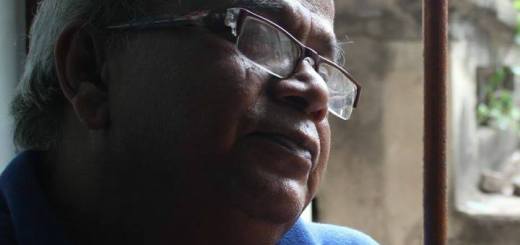
 Jiban Narah was born in 1970, in the remote Morangial village, in Golaghat district of Assam. He imbibed the Brahmaputra valley culture on which his native Mishing tribe, along with many other similar tribes, and the mainstream Assamese society have impacted in a major way. A riverine indigenous tribe of Assam, the Mishings are fiercely proud about their cultural identity, and Jiban could have been bound in by its particularity. However, crouching behind the limiting confines of his environs, Jiban has leapt across chasms, enabling his own unique self expression as a poet of national stature. Nevertheless, he kept his ties with his community intact at all times, and the result is that while establishing himself in the mainstream Assamese poetry, the spirit of Mishing tribal culture enlivens the core of his works.
At a very young age, he caught the imagination, not only of his native Assamese, but also of many other language communities of India where he reached through translations, like Malayalam into which the noted poet Anvar Ali translated him as early as 1997. His poems have been rendered also into English, Bengali, Tamil, Hindi, Marathi, Oriya, Gujarati and Manipuri. He has participated in major poetry reading events across the country, organised by Sahitya Akademi and other major literary organisations, over the last two decades.
Jiban Narah has six books of poems in Assamese, one novel, a collection of personal essays and a compilation of Mishing poetry translated into Assamese. His book of Mishing folk poetry translated into English, titled, Listen My Flower Bud: Mishing Tribal Oral Poetry of Assam (2008) was published by Sahitya Akademi. The Buddha And Other Poems (2009), English translation of his poems, was published by Monsoon Edition, Kozhikode.
Revered Assamese poets like Navakanta Barua, senior critics, academics and translators like Kabin Phukan, Hiren Gohain, Pradip Acharya, Geetashree Tamulay, Prabhat Bora, and the patriarch of Modern English poetry in India, Jayanta Mahapatra, have evaluated and recognised Jiban’s poetry as uniquely brilliant. Jiban’s poetry, much like the vibrant Chinese or Japanese symbolist poetry and unlike the obscure yet intense French symbolist poetry as opined by Kabin Phukan, has drawn from his native culture and arrived where it has, as his natural expression. However, Geetashree Tamulay likens the craft of his poem, “Colours” to that of the French Symbolist Rimbaud. Pradip Acharya remarkably notes that, “…the faith on nature-dependence nurtured by Jiban Narah in the mid-nineties is significant both for literature and society.” He further observes that this oneness with nature is the keystone of post-modernist literature as demonstrated by Garcia Marquez, Salman Rushdie and Orhan Pamuk. Jiban being credited with such an important role in Assamese literature by a venerable critic and translator like Pradip Acharya speaks volumes for the importance of this poet. Navakanta Barua says of his poetry: “Jiban Narah shows that the folk is part of us and folkways make direct inroads into modern poetry and inform his idiom which is regular and catchy…. He is a poet of distinctive character. He brought in a new sensuous quality to the otherwise intellectual modernity of many of his contemporaries.”(The Book Review, Vol.XXI.)
Poet Bio by A.J.Thomas, Poetry Editor, Y Blog